Showing posts with label Overseas Development. Show all posts

Friday, August 31, 2012

No Dig Gardenbeds & The Village Crazyman

A social pattern that Rick Coleman has observed in his work overseas is that of the 'Village Crazyman':

Everywhere he has worked, Rick has encountered this person - typically slightly overweight (ie well-fed), and the only person in his village who is growing anything with any success - often with raging success, while everyone around has written him off as 'crazy'; simply because of the lack of social proof: 

If that guy was doing things so right, then why isn't everyone else doing it?

Africa, Peru, Mexico, Palestine, Mongolia; wherever he went, sooner or later he would eventually run into this person, and when he did… it would be time to ask lots of questions & take furious notes… and ironically enough, when Rick returns home to his productive permacultural bio-dome smack-bang in the middle of the declining pastures in Gippsland (considered prime dairy country in that neck of the woods), guess who the neighbors consider to be the crazyman?

Cimg5023_-_version_2
Photo: Our new friend Sawi is Da Man!

When we first met Sawi during our tour of Ifira Island on Day 1 of this consultancy, it was clear that he was doing some very good things - but it wasn't until we had conducted our site visits to Araki Island & Dixson's Reef that it started to become clear that we had found our 'Crazyman'.

One consequence of the relative material affluence of this small community is a preference for buying cheap, processed & imported foods, and Sawi is one of the few residents of Ifira Island still growing his own food: trained chickens, free-range-non-foraging pigs, cyclone yams (not a typo), fruit & nut trees, hessian-crete walls (hessian bags dipped in concrete and used as a sort of plaster), thermal-efficient roasting oven, handmade fishtraps, compost heaps, nursery operations - he's got a lot going on.

Check out these no-dig garden beds, made from treestumps, compost, & leaf litter, growing 'cyclone yams' (wild yams which can store in the ground for many seasons and can act as a backup food supply in case of cyclones), at least 3 different varieties of Island Cabbage (Abelmoschus manihot, aka Edible Hibiscus), an unidentified shrubby edible, and interplanted with colorful varieties of Coleus to attract beneficial insects:

Dscn4460

Photo: No-dig Gardenbeds on Ifira Island in Vanuatu.

Photo: Three different varieties of Island Cabbage (Abelmoschus manihot, aka Edible Hibiscus).

Dscn4461
Photo: Mushrooms thriving on the decomposing log borders.

Wednesday, August 22, 2012

Vanuatu 2012: 'Kaekae fo Laef' (Food For Life)

Dscn4672

Photo: The view from the plane on the way to Malekula Island.


“Food security has been defined as ...access by all people at all times to sufficient food for an active and healthy life.  
- (Online), Dieticians Association of Australia, www.daa.asn.au (2006.) -


Dscn4601

Photo: The open market in Port Villa is filled with a diverse variety of local produce & goods


Food Insecurity
Food insecurity in Vanuatu is not primarily a case of inadequate volumes of food to feed people. 

[TGB: In fact, our site visits to two remote island communities (one accessible only by a 60-minute banana boat ride) revealed a richness in diversified perennial cropping systems and a deep knowledge of local plants & their uses.  We also discovered a fondness for consuming large amounts of cheap imported white rice.]

(Food insecurity in Vanuatu) is more related to what can be termed “hidden hunger”, or deficiencies of vital micronutrients in people’s diets. In rural areas, it is related to people eating unbalanced diets, and a building dependence on imported convenience foods (rice, noodles and tinned fish).

Dscn4445

Photo: Typical household on Ifiri Island, a small island community located a short 10-minute boat ride from Port Villa.

In urban areas, it is related to people’s access to land, the ability to earn sufficient income to purchase food, and changes in people’s eating habits, shifting away from nutritionally rich traditional staples to imported, less nutritious food items.

In both rural and urban Vanuatu, there is physical evidence of some malnutrition amongst infants, pregnant and lactating women, low-income earners and the unemployed. Not all people are able to get access to enough food.

Findings from the 1983 National Nutrition Survey (no other recent work of this kind has taken place since) indicate that malnutrition is noticeable amongst children between 1 and 2 years of age in rural Vanuatu. In urban areas the problem is more prominent amongst low-income earners, who cannot earn sufficient income to meet the full food needs of their households.


Increasing Soil Infertility
Shifting cultivation is still widely practised in the rural areas of Vanuatu, where land is cleared, cultivated for a number of years, and left fallow while families move to a new piece of land to repeat the process.

Dscn5056

Photo: Slash-and-burn garden plot ready for planting, Araki Island.

After each cultivation period, the soil is drained of almost all available nutrients. Therefore, a long fallow period is required to let the soil recover. It has been estimated that it can take as long as 15 to 20 years for land to recover fully in the tropics.

In the past, when population pressure was low this fallow period was feasible. However, in more recent years, the fallow period has been shortened to as short as two years or even less, particularly on the more populated islands.

Most rural families in Vanuatu are semi-subsistence farmers. These families are reporting differences between yields of crops harvested each time a piece of land is re-cultivated.

Dscn4756

Photo: Slash-and-burn garden plot planted 3 months ago, Dixson's Reef.

Declining food crop yields are most likely directly related to declining soil fertility, which is an outcome of shorter fallow periods, which in turn are a consequence of land pressure that is linked to increased monoculture of cash crops and rapid population growth.

In the search for fertile soils for new gardens families are clearing forests a long way from their homes, often up to a full day walking distance.

This is creating pressures on women and children as they must travel long distances for the cultivation and harvest of food, which is contributing to preferences for nutritionally poor, imported non-perishable foods such as rice, noodles, etc (TGB: it is far easier to go to the local convenience store or bulk-buy processed foods from the supermarket than to walk a full day to-and-from your sustenance plot every day).


Brief Description of the Proposed Project
This project will improve food security through the introduction of innovative agriculture practices and training based on the permaculture approach that will allow intensive vegetable cultivation in gardens within the village, using organic methods that retain soil fertility year round.

The innovative gardening approaches will build on the gardening skills of rural families, and allow them to trial new ways of growing, processing and preserving their traditional crops. The project will work directly with families in two rural communities on Malekula and Santo Islands, and one poor urban settlement community in Port Vila.

Dscn4460
Photo: At least 3 different varieties of Island Cabbage (Hibiscus manihot) grow as a planting guild in raised beds with Yams, Coleus, and an unidentified edible leafy green shrub (in front of logs). [Ifira Island]

Permaculture is based on creating closed ecosystems for growing food that are as natural as possible and meet all their own needs internally, such as supplying pest management, nutrients for all species, temperature control, soil building and maintenance, wind control, pollination, germination and pruning.

Key aspects of permaculture are intercropping for pest management and creation of microclimates that support the differing cultivation needs of the vegetables grown. A development opportunity that this project will be built upon is that some of the key practices of permaculture are already part of traditional Vanuatu gardening practice.

Currently the constraint is that the food gardens in Vanuatu are placed a long distance from the village, and the practice of slash/burn agriculture is depleting soil fertility to zero. Mono-cropping is another farming system practised primarily for cash crops such as coconut, cocoa, coffee and kava.

Cimg4551

Photo: Coconut plantation on Malekula.

Permanent cash crops tie up land for long periods of time, resulting in shortages of suitable land for food crop production. Due to the value of the cash crops these are often located on the fertile soils closest to the village, another reason why food gardens are located so far away.

This project will use permaculture approaches to allow families to build on the integrated planting methods they are familiar with in order to cultivate complimentary food crops within their cash crops.

Rural families in Vanuatu also keep animals as sources of food or income, such as chickens, ducks, goats, pigs and some beef cattle. Usually this livestock ranges freely throughout the village, making establishing vegetable gardens impossible – especially if the villagers keep pigs.

Dscn4822

Photo: Pigpens in Dixson's Reef Community.

A key aspect of the permaculture approach is the integration of livestock into the gardening system, as livestock both consume garden waste (fodder for goats or cows, or rotting vegetables for pigs), manage insect pests (chickens and ducks) and produce very fertile manure.

This project will work with the rural villagers so that they are able to integrate their livestock into their gardening practice, which will result in greater soil fertility and improved pest management. Sustainable vegetable production training will focus on seed saving, soil fertility, natural pest management, and water conservation for coastal communities with a long dry season.

Dscn5019

Photo: Solar dryer in Araki Island.  These Beach Almonds are harvested by the local children and sold at market for 400VT /kg ($4USD).

Food processing and preservation techniques will also be introduced to the communities. Currently there is a high demand for this type of knowledge. This project will have a high potential for replication across Vanuatu.

In order to facilitate this the project will work with the Vanuatu Department of Agriculture and possibly a rural vocational training provider to develop curriculum materials based on the lessons learned and the approaches developed through the project activities.

These training materials will then be used to replicate the knowledge and skills so that agriculture extension workers can provide the knowledge to communities in other parts of Vanuatu, and young people at vocational training centres can obtain certificates in the permaculture approach.

 - Excerpts from ADRA Australia 'Kaikai fo Laef' ['Food for Life'] Concept Note written by Michelle Abel & Tileuybyek Ye, September 2011 -


Friday, December 16, 2011

Banana leaf sheet mulch!

Dscn0922
Photo: Banana leaf sheet mulch deployed in raised bed garden.  Hana, Maui.

Banana leaves have many uses in the Islands (and in all traditional cultures where banana plants grow), though here's one you may not yet have considered:  a natural, locally & readily available, biodegradable weed barrier for sheet mulching.

In urban and suburban Honolulu, cardboard is a readily available waste product that can easily be upcycled as a biodegradable weed barrier for sheet mulch gardenbeds and paths, though in remote Hana there is nowhere near the amount of waste cardboard available for us permaculturists!

There is, however, and abundance of banana plants (which love the chocolatey-volcanic soils and moisture), and therefore an abundance of banana leaves...

...which brings us to the point of this post:

Appropriate Design.
(an excerpt from Rick Coleman's essay 'The Role of Permaculture in Sustainable Aid')

If you are going to introduce a new technology / technique / tool, these are some things to consider:

  • Can you use materials that are inexpnsive or free, that are easily accessible and safe?
  • Will it have a tangible positive effect on the community (as well as the aid organization)?
  • Most importantly is it able to be repeated (if you build a grand-darble-dooble-funky and leave it, can anyone build a new one?)..
  • How can the technology be integrated to solve other problems or be connected to other elements (in the system) and therefore become more productive?

... which, of course, now leaves us with the question:

  • What else could we use banana leaves for?

While we ponder that one, here's another example of a locally appropriate material being deployed for use in a sheet mulch garden being built in the drylands of Mexico:


Thursday, April 14, 2011

SEAL Project awarded 6 hectares for Permacultural development

Tilyeubyek 'Bek' Yeltai, Food Security Director for ADRA-Mongolia, confirmed today that the local governments of Ulgii City and Bugat soum in Bayan Ulgii province have awarded two 3-hectare land parcels to the SEAL Project for development into permacultural demonstration and education sites.

"We are working on designs for the parcels now," said Bek. "The land parcels are barren and rocky, but the soil underneath looks rich and moist; they are close to the river, and sheltered by the nearby hills."

The list of 146 useful plant species suitable for growing in Bayan Ulgii's climatic conditions compiled Dr Beket's research team over the last few years will be a valuable resource to support the design for this new development in the SEAL Project.

Establishing large-scale demonstration sites give Project staff another location to conduct trainings, and a place to test experimental designs and techniques (such as plant guilds, worm farm designs, and mycellium innoculation of soils) for their effectiveness before implementing new ideas into the field (where an ineffective design could cause a family to go hungry).

The SEAL Project team will document development of the sites with photography and video (coming soon), to show how quickly a bare patch of land can be brought into production through permaculture and regenerative design.

We'll keep you posted!

Ulgii_city_iia

Photo: View of Ulgii City, from the base of the surrounding hills.

Sunday, March 27, 2011

Mongolian Permaculture: What's next? (Day 22)

Theme song of the day: 'Just Breathe' by Eddie Vedder.  His lyrics just couldn't say this any better.

Scpi_pdc_09
Photo: graduating class of Dec 2009 PDC at SCPI

It's been about 15 months since I stumbled across permaculture at Rick and Naomi Coleman's Permaculture Design Course at the Southern Cross Permaculture Institute in Leongatha (Victoria, Australia).

I had run out of money, moved back home with my parents in Melbourne, and, in search of what was next for me in the adventure that is my life, I had applied for a position studying Landscape Architecture at RMIT University in Melbourne.  There was no way of knowing on day one of my PDC that in just over a year, I would have been to Mongolia twice, covering an area from the Gobi Desert in the south to Zavkhan province in the northwest, to the Kazakh stronghold of Bayan Ulgii in the far west; and working on projects making a positive contribution to Mongolian communities all along the way... life is strange, and unpredictable, and beautiful.
 

Pdc_dec_09_017

Photo: Bek 'The Mongolian Maniac' wrestles with Dave 'The Ghost' Gibb at Wilson's Prom during our PDC rest day.

The new humble Monoglian friend I made on that course turned out to be the Food Security Director of an international NGO, and the small pact we made over the campfire one evening (to visit each other's homelands) is growing into an international collaboration of knowledge & resources that could help vastly different cultures connect, and learn from each other.

It's Bek's turn to visit my homeland since I am 2-0 in the visit tally right now, but first he has his work cut out for him with establishing a strong foundational year for the SEAL Project, and the other permaculture-based projects he is implementing throughout Mongolia (permaculture has been integrated into all of ADRA-Mongolia's Food Security initiatives).

600 integrated root cellars, and 600 passive solar greenhouses equipped with 600 drip-irrigation systems will be built for carefully selected beneficiaries throughout Bayan Ulgii province in the next year, as part of a 4-year plan to strengthen local food security and stimulate the local economy (with microenterprises and Self-Help microfinance groups) by seeding the community with these permaculture demonstration sites and future permaculture teachers.

Bolhadt
Photo: 'Bolhadt', Project beneficiary living in Sagsay soum.  He is married, has 2 young children, has an existing root cellar installed under his house, is already farming his own worms, and has some experience growing potatoes and turnips.

Beneficiaries are screened not for their level of needs (this would be applicable to an 'aid' or 'relief' effort), but rather for their character, motivation, and potential to become future community leaders once equipped with the tools, knowledge, and opportunity to create positive, regenerative change in their own lives.  Checks and balances (such as monitoring gender-ratios and potential conflicts-of-interest) are designed into the selection process to maximize the project's potential for success.

Like all projects and organizations, the quality of results created is entirely dependent upon the quality and character of the people driving it, and based on my experience of the eleven ADRA staff devoted to this project, and the leadership & vision of Bek, Doc, and Michelle Abel (Programs Director) from ADRA-Mongolia's head offices in UB, integrity levels are high and the project is off to a very good start. 

One heartfelt conversation I had with project staff in the closing days of the course revolved around my personal experience of how many friends came forward to support me emotionally, practically, and even financially while I watched the small fortune I made during my twenties be taken away; when the money was gone, all that was left was the people I had touched - and I was humbled to find out how many that is, and how rich I truly am.

The SEAL Project staff have a similar opportunity, in that the work they are being paid to do over the next four years will touch many lives and forge many relationships that would be challenging to create outside of this context; if project staff focus on taking care of their people the best way they know how, than each one of them will be richer than they can imagine by the time the project ends - and we are talking about true wealth: the wealth of rich and supportive relationships, not the transient & deceptive wealth of money.
Bastama
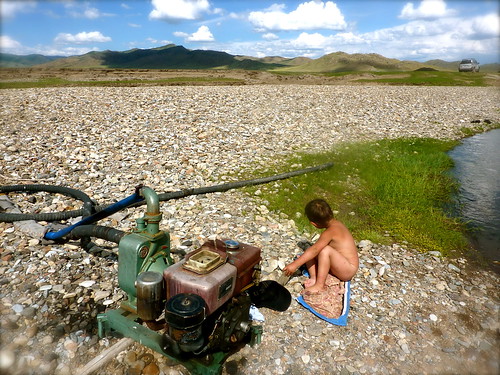
Photo: Bastama School Gardens project.

Dr. Beket's Bastama School Gardens project has the potential to impact an additional 500 students and families, while Guliya's large-scale fruit & vegetable production plot could also impact countless more.  In this way, we plant the seeds of permaculture design with 13 students, and watch it grow to help over 1,100 families move towards a sustainable & regenerative future.

As for me?  Well, I couldn't have done any of this work if not for the foundation laid by the many permaculturists who have gone before me, especially the work done by Rick Coleman and Kat Lavers during the 2010 Mongolian Permaculture project; had it not been for that experience and learning curve, I would not have a strong enough baseline of knowledge & experience to be effective here, and in fact it would have been irresponsible to send me in lieu of a more experienced instructor.

Rick_n_kat

Photo: Rick and Kat, Mongolian Permaculture 2010

I was able to be effective in Mongolian conditions, and adapt the lessons I learned last year to Mongol-Kazakh culture, only because of the time, money and effort dedicated towards skilling up, and learning from others who were so willing to share with & teach me.  Now I have a stronger baseline to operate from when working in Sustainable Aid and Overseas Development, but there are knowledge & experience gaps (especially in creating and cultivating my own productive & functional crop systems) that I need to fill.

Bill Mollison said it best in the Global Gardener series:

'Once you've set up your home, so that you can leave it for 2 or 3 months and it just gets better, so that you are free to travel, then you can go and teach other people.' 

- Bill Mollison -

So that's what is next for me:  return to Hawaii, marry the woman I love, put some roots down, and start growing some veggies. 

Come visit if you are in the area.

Wind_n_light
Photo: Wind & Light ride in Hawaii.

Home
Photo: HOME.


Friday, March 11, 2011

Chickens in Bayan Ulgii (Day 14)

Normal 0 false false false EN-US X-NONE X-NONE MicrosoftInternetExplorer4

[Excerpt from SEAL 2011 Permaculture Design Training Report, by Matthew Lynch]

Mongolian chickens are very cold hardy breed that lay one egg every 1-2 days from March until October.  There are successful breeders currently raising chickens in Ulgii City; ADRA staff brought us to one family hasha during our pre-course resource inventory to meet with a breeder and view her system.

P1000689
Photo: Heavily insulated chicken house design with warm-weather chicken run attached to entryway.

A small, well-designed and  fully insulated (including the floor) earthen shelter is sufficient to keep the chickens warm throughout the winter without active heating.  The site we visited had a small earthen chicken house (approximately 2 x 1 x 1 meters) nestled in a corner between the outer hasha wall and an earthen block storage shed, with a south-facing aspect.  A small caged chicken house of similar dimensions was built over the entryway for use in warmer months. 

The compact size and strong insulation (layers of felt insulation were also installed over the floor) of the winter shelter helps to conserve the chickens' precious body heat, which was sufficient to heat the chicken house throughout the winter.  Household food scraps and grain bought from the local market provide their feed, and they are let out during the day to forage and scratch in the hasha courtyard.  The children bring the chickens water from the house, and the shelter is cleaned out once every couple of weeks.

P1000684
 Photo: The Rooster watches over his hens.

Chickens_huddled_together_against_the_cold
Photo: The flock huddles together against the cold.

P1000682
Photo: The owner demonstrates how she calls the chickens to feed.

This flock of 10-12 chickens has been thriving for the last 10 years in this design, laying 5-10 eggs per day from March - October, providing eggs, meat, and baby chickens when need, as well as an additional family income of 300MNT per egg (360,000 - 720,000MNT annually)(i).  A strong demand for fresh eggs exists, and this family is easily able to sell all their surplus eggs to the neighbours. 

Successfully introducing chickens into a permaculture system for Ulgii City will have multiple benefits: increasing food security, boosting nutrition, building soil fertility, and creating additional income sources from microenterprises based upon chicken products (eggs, meat, baby chickens, perhaps even baking).

The existing design, while effective, could be modified to become more productive, functional, and resilient by integrating the chickens into a permacultural food production system. 

For example, a passive solar greenhouse would make an excellent winter run for the chickens, keeping the birds out of the wind and in the warmth of the sun during the day, while providing fertility and preparing the soils for a jump-start on the short Mongolian growing season.  Locating the heavily insulated winter shelter next to the greenhouse (so that it can be entered from the courtyard or from the greenhouse) could make it easier to clean; a larger door could be installed on the greenhouse side of the shelter (since it opens into a warm still-air chamber), and the dropping simply swept out into the greenhouse to be used as fertilizer.

Fruit trees such as seabuckthorn and blackcurrant could be grown along the hasha walls, to take advantage of the chicken manure during warmer months when the birds can be let out of the greenhouse.  Grasses and 'weeds' such as fat hen and plantain, could be cultivated and encouraged within the hasha walls and fed to the chickens to boost the quality of the eggs (layers who are fed greens will produce eggs with healthy, bright yellow yolks).

P1000695
Photo: These chickens' hasha courtyard is bare.

P1000681
Photo: Outer entrance.

P1000692

Photo: Inner entrance.

P1000686
Photo: Family watchdog doubles as chickens' bodyguard.

P1000698
Photo: Chicken's bodyguard warns us off.

____________________

(i) 1,500 MNT per month would be considered a strong salary in Bayan Ulgii.

Friday, February 25, 2011

Regenerative business v1.0 [Bayan Ulgii SEAL Project 2011]

Draft 1.0, 'Fundamentals of Regenerative Business' learning module for SEAL Project 2011.

This session will be taught to Heads-of-household Beneficiaries and ADRA-Mongolia Field Staff, to lay the foundational understanding of creating and running a business which strengthens its community by cycling energy and money into its local markets.

Concepts are presented and explained via slideshow & lecture, then will explored and discussed during subsequent group activity, in which students will design their own Self-Help Group or Credit Co-operative Enterprises.

The final version will be translated into Russian, as the Kazakh residents of Bayan Ulgii are fluent in this language from 'Socialism Times' (as locals refer to the Soviet regime).

image: Permaculture Principles applied to Business Fundamentals.

Wednesday, February 23, 2011

Pattern literacy: Bayan Ulgii SEAL Project 2011 v1.0

Photos and imagery of local examples provide discussion points to explore how pattern literacy can be utilized to inform the design process.

View the complete presentation here.

Wednesday, January 5, 2011

A Beginner's Guide to Working in Sustainable Development

[Note: this post originally appeared on the PRI's website, and is reposted here with the hyperlink index included at the end of the article.  There are many valuable references linked to throughout the piece, which may be more conveniently accessed after you have read the article in its entirety.]


We can change the world.  We’ve all felt it, that overwhelming urge which every permie gets when they graduate from their PDC, that burning desire to share our excitement, to spread the good word, to let the rest of world in on the little secret we’ve just discovered: “WE’VE GOT SOMETHING HERE THAT CAN REALLY HELP US ALL, IF YOU WOULD ONLY JUST LISTEN!!”[i]

And it’s true.  We are on to something.  We really can solve all the world’s problems in our gardens.[ii] 

Though before we beginners rush out to save the world, it is important that we step back, slow down[iii], take a brutally honest look at ourselves, and identify the gaps in our experience, knowledge, abilities, and skill-sets that we need to fill - before we take the plunge of working in international aid.

The old saying goes: “The road to hell is paved with good intentions,” and this is especially true when it comes to foreign aid.  Listen to any seasoned permaculture aid worker[iv] long enough, and they are bound to tell you dozens of frighteningly embarressing stories[v] of well-intentioned aid gone wrong, or at least being less effective than they could have[vi].

After completing my 72-hour PDC at Southern Cross Permaculture Institute (SCPI)[vii] in December 2011, I was eager to rush out and do my part to help end poverty[viii].

After all, I have ten years of experience in small business, taught finance and real estate all over the State of Hawaii, and was able to make a lot of people a lot of money back in the days when I ran my little firm[xi].  Surely, I told myself, I had something to contribute?

RICK'S DAILY COMMUTE TO TEACHING
THE PDC IN NEPAL, 2001.
So I asked Rick Coleman[xii], who in his 18+ years teaching permaculture has worked in some of the harshest conditions, on every continent [except Antarctica], with some of the poorest people in the world, if I had what it takes to work in Overseas Aid and Development. 

His answer was direct, painfully simple, and borne from the frustrating perspective of bearing witness to countless aid agencies inadvertently making mistakes – and risking countless lives – in well-intentioned, but ill-informed efforts to make a difference:

“Have you ever grown enough food to feed your family?”

Erm, hmmmm, uhhhh…..Right.  Good point.  He had me, and he knew it; and he went on to say:

“When we work in the developing world, the stakes are very high: if you make a mistake, someone goes hungry, someone cannot feed their child that day.  We must design carefully to avoid precarious situations, or we are taking extreme risks with people’s lives.”
-Rick Coleman-


“Once you’ve set up your own home, so that you can leave it for 2 or 3 months and it just gets better, so that you are free to travel, then you can go and teach other people.”
  - Bill Mollison -

Then, perhaps sensing that in three short sentences, he may have crushed all of my hopes and dreams for ever working internationally, Rick planted a seed:

“You can build upon your strengths and experience in business and finance, take that and translate it into permaculture aid.  For example, microfinance and enterprise development could become your core strength in this field.” 

“You can grow into an effective teacher, though first you’ll need to study the pedagogy of how to teach permaculture - it’s one thing to tell, and quite another thing to teach.”
-Rick Coleman-

…and so seven months later I wake up in a ger [yurt], my belly in knots[xiv] from too much tsu-te-tse [traditional salty milk tea] drunk the night before, and dash outside, into the achingly cold morning and over to the pit latrine at the edge of the hasha [family compound], which has been dug barely high enough so that I can avoid embarrassing splatters - if I can only squat deftly enough.

CLASS PHOTO IN ZAVKHAN PROVINCE, NORTHWESTERN OUTER MONGOLIA
I’ve spent the last six months living and working on Rick’s farm: shovelling shit into no-dig garden beds[xv], wheeling wheelbarrows around landscaping projects[xvi], swinging a hammer[xvii], slinging strawbales around houses made of natural and recycled materials[xviii], loving every mud-splattered minute of it and doing all I can to learn and skill up, and somehow be helpful enough to justify a spot on the team for his next overseas consultancy…

…and now, I am waking up in the Outer Mongolian province of Zavkhan, supporting a Sustainable Aid consultancy for ADRA Mongolia[xix], who has sponsored us to teach the country's first-ever Permaculture Design Course[xx], to the nomads whose herds had been decimated by increasingly harsh winters.

Rick’s team includes Kat Lavers [of Transition Towns Darebin[xxi] and The Plummery Urban Permaculture Demonstration Site[xxii] in Melbourne], a young though experienced permaculture teacher and activist, and, well …me.  Bek[xxiii], my good friend and PDC classmate is also there, because he is a native of Mongolia, and also happens to be the Director of Food Security for the NGO – who have done a good job in laying a foundation for permaculture to become well-integrated into their design solutions and operations by investing in their staff’s Permie-powers.

PETROL PUMPS, PREVIOUSLY CONSIDERED TO BE AN ASSET, WERE RE-CLASSIFIED BY STUDENTS
 FROM A PERMACULTURAL PERSPECTIVE AS A LIABILITY IN FAVOUR OF RAM PUMPS,
WHICH HAVE ONLY TWO MOVING PARTS AND HARNESS THE RIVER'S FLOW
TO PUMP WATER UP TO THE GROWING PLOT.
You should try gardening here:  -40 C winters, ancient beach sand for soil[xxiv], super short growing season, and little access to water.  Some co-operatives are watering 20 plus acres by hand[xxv], and apart from that Mongolians don’t even like to eat vegetables – they’ve never had the luxury of being able to choose a vegetarian diet. 

I am glad that I heeded Rick’s advice, took time to build my Permie-powers, and then found seasoned, successful teachers willing to take me under their wing; this way I gain invaluable on-the-ground experience that cannot be gleaned from a website, classroom or two-week course [no matter how intensive].  I am able to collaborate on design solutions, make attempts at reading the landscape[xxvi], and bounce ideas around within the safety net of my more experienced companions.

Most importantly, this minimizes the chances that I will make any beginner’s mistakes[xxvii] that could cause a family to go hungry.

“A Permacultural System looks at designing for the extremes.  Especially when working in aid, we design first for Survival, then Subsistence, then Self-Sufficiency, and then Abundance of Harvest [where crops can be bartered or given away].  Finally, we can move on to Commercial production.”
  – Rick Coleman –

My primary role here is to support the other two, and document the project with photos[xxviii], video[xxix], and a daily blog[xxx] that we can use as a teaching tool for other permies wanting to develop the experience, knowledge and skills necessary for working effectively in Permaculture Aid. In true multi-functional-permie-fashion, I’ve also arranged with my AQTF, nationally accredited T.A.F.E. level Permaculture Diploma [xxxi] Instructor that my blog can do double-duty and count towards my assessment tasks in the course.

My secondary role is to assist in setting up and conducting any practicums, like building a compost heap[xxxii] or any of the other fun learning activities every permie gets to do on their PDCs.  Then, the best surprise ever: in week four of the project, Rick works with me and draws from my experience to develop a lesson plan for the session on Microfinance; then he asks me to teach the session, and all of a sudden I am teaching business and finance to the descendants of Ghengis Khan’s fearsome army[xxxiii].

Dreams, even the really weird ones, really do come true.

KNOWLEDGE WAS TRANSFERRING BY DAY 2 OF THE PDC.
DEAD WEEDS, PREVIOUSLY SLASHED AND REMOVED FROM THE SITE,
WERE BEING COLLECTED TO BE USED AS MULCH, CYCLING NUTRIENT BACK INTO THE SYSTEM,
RETAINING SOIL MOISTURE, AND IMPROVING SOIL QUALITY OVER TIME.

---------------------------------------------------------------------
Postscript:

It’s now been four months since I got back from the Mongolian Permaculture Project, and I am currently living in an entirely different place (Hamburg, Germany), and working on new and different projects; but that, my friends, is another story for another day.

Right now we’d like to tell you about an opportunity to make your dreams [however weird] of working internationally as a permaculture aid worker come true:

GRADUATING CLASS OF MONGOLIA'S INAUGURAL PDC CLASS OF 2010.
The Australian Youth Ambassadors for Development (AYAD)[xxxiv] and ADRA Mongolia[xxxv] are looking for a suitable candidate for an expenses-paid, 12 month volunteering opportunity, in conjunction with AYAD and ADRA.  The successful candidate must be under 30 years of age, and have minimum qualification of Permaculture Design Certificate[xxxvi] or equivalent diploma / certificate in related field [such as Horticulture, Ecology, Agronomy, etc].

The official position title is “Food Security Technical Officer, specialising in permaculture and organic gardening”.

Duties will include: “assisting to teach refresher courses to Food Security Staff in permaculture principles and practice, developing appropriate permaculture manuals, conducting field assessments to community gardens, and providing technical advice and research on implementation of identified permaculture practices in the Mongolian context.”

The successful candidate will report to ADRA Mongolia’s Food Security Director, who is a PDC graduate with a background in agronomy and hydro-engineering.

You’ll have to be quick though, applications for the position close on January 19th, 2011 …share this article and help spread the word to anyone else you think might be qualified and interested!

Contact me, or ADRA Programs Director Michelle Abel, for more information and to get your application started.


Hyperlink index:
[i] Geoff Lawton’s ‘Through the Eyes of Permaculture’ 2:00 youTube video
[iii] permaculturePrinciples.com ‘Small and Slow Solutions’
[viii] ‘The End of Poverty’ documentary film trailer
[ix] permaculture.org.au 'Geoff Lawton's Greening the Desert' 5:20 youTube video
[xii] Rick Coleman’s ‘Why We Teach Permaculture' 1:58 youTube video
[xiii] Bill Mollison’s ‘Global Gardener: Bill talks about his garden' 6:36 youTube video
[xv] Rick Coleman’s ‘Sheet Mulch Gardening in the Deserts of Mexico' 5:07 youTube video
[xxii] Michael Green, freelance journalist on ‘Permaculture'