Showing posts with label SCPI. Show all posts

Wednesday, January 5, 2011

A Beginner's Guide to Working in Sustainable Development

[Note: this post originally appeared on the PRI's website, and is reposted here with the hyperlink index included at the end of the article.  There are many valuable references linked to throughout the piece, which may be more conveniently accessed after you have read the article in its entirety.]


We can change the world.  We’ve all felt it, that overwhelming urge which every permie gets when they graduate from their PDC, that burning desire to share our excitement, to spread the good word, to let the rest of world in on the little secret we’ve just discovered: “WE’VE GOT SOMETHING HERE THAT CAN REALLY HELP US ALL, IF YOU WOULD ONLY JUST LISTEN!!”[i]

And it’s true.  We are on to something.  We really can solve all the world’s problems in our gardens.[ii] 

Though before we beginners rush out to save the world, it is important that we step back, slow down[iii], take a brutally honest look at ourselves, and identify the gaps in our experience, knowledge, abilities, and skill-sets that we need to fill - before we take the plunge of working in international aid.

The old saying goes: “The road to hell is paved with good intentions,” and this is especially true when it comes to foreign aid.  Listen to any seasoned permaculture aid worker[iv] long enough, and they are bound to tell you dozens of frighteningly embarressing stories[v] of well-intentioned aid gone wrong, or at least being less effective than they could have[vi].

After completing my 72-hour PDC at Southern Cross Permaculture Institute (SCPI)[vii] in December 2011, I was eager to rush out and do my part to help end poverty[viii].

After all, I have ten years of experience in small business, taught finance and real estate all over the State of Hawaii, and was able to make a lot of people a lot of money back in the days when I ran my little firm[xi].  Surely, I told myself, I had something to contribute?

RICK'S DAILY COMMUTE TO TEACHING
THE PDC IN NEPAL, 2001.
So I asked Rick Coleman[xii], who in his 18+ years teaching permaculture has worked in some of the harshest conditions, on every continent [except Antarctica], with some of the poorest people in the world, if I had what it takes to work in Overseas Aid and Development. 

His answer was direct, painfully simple, and borne from the frustrating perspective of bearing witness to countless aid agencies inadvertently making mistakes – and risking countless lives – in well-intentioned, but ill-informed efforts to make a difference:

“Have you ever grown enough food to feed your family?”

Erm, hmmmm, uhhhh…..Right.  Good point.  He had me, and he knew it; and he went on to say:

“When we work in the developing world, the stakes are very high: if you make a mistake, someone goes hungry, someone cannot feed their child that day.  We must design carefully to avoid precarious situations, or we are taking extreme risks with people’s lives.”
-Rick Coleman-


“Once you’ve set up your own home, so that you can leave it for 2 or 3 months and it just gets better, so that you are free to travel, then you can go and teach other people.”
  - Bill Mollison -

Then, perhaps sensing that in three short sentences, he may have crushed all of my hopes and dreams for ever working internationally, Rick planted a seed:

“You can build upon your strengths and experience in business and finance, take that and translate it into permaculture aid.  For example, microfinance and enterprise development could become your core strength in this field.” 

“You can grow into an effective teacher, though first you’ll need to study the pedagogy of how to teach permaculture - it’s one thing to tell, and quite another thing to teach.”
-Rick Coleman-

…and so seven months later I wake up in a ger [yurt], my belly in knots[xiv] from too much tsu-te-tse [traditional salty milk tea] drunk the night before, and dash outside, into the achingly cold morning and over to the pit latrine at the edge of the hasha [family compound], which has been dug barely high enough so that I can avoid embarrassing splatters - if I can only squat deftly enough.

CLASS PHOTO IN ZAVKHAN PROVINCE, NORTHWESTERN OUTER MONGOLIA
I’ve spent the last six months living and working on Rick’s farm: shovelling shit into no-dig garden beds[xv], wheeling wheelbarrows around landscaping projects[xvi], swinging a hammer[xvii], slinging strawbales around houses made of natural and recycled materials[xviii], loving every mud-splattered minute of it and doing all I can to learn and skill up, and somehow be helpful enough to justify a spot on the team for his next overseas consultancy…

…and now, I am waking up in the Outer Mongolian province of Zavkhan, supporting a Sustainable Aid consultancy for ADRA Mongolia[xix], who has sponsored us to teach the country's first-ever Permaculture Design Course[xx], to the nomads whose herds had been decimated by increasingly harsh winters.

Rick’s team includes Kat Lavers [of Transition Towns Darebin[xxi] and The Plummery Urban Permaculture Demonstration Site[xxii] in Melbourne], a young though experienced permaculture teacher and activist, and, well …me.  Bek[xxiii], my good friend and PDC classmate is also there, because he is a native of Mongolia, and also happens to be the Director of Food Security for the NGO – who have done a good job in laying a foundation for permaculture to become well-integrated into their design solutions and operations by investing in their staff’s Permie-powers.
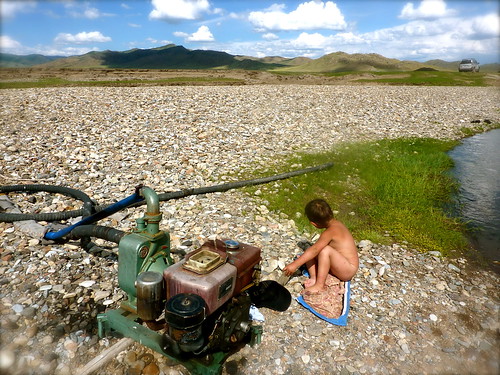
PETROL PUMPS, PREVIOUSLY CONSIDERED TO BE AN ASSET, WERE RE-CLASSIFIED BY STUDENTS
 FROM A PERMACULTURAL PERSPECTIVE AS A LIABILITY IN FAVOUR OF RAM PUMPS,
WHICH HAVE ONLY TWO MOVING PARTS AND HARNESS THE RIVER'S FLOW
TO PUMP WATER UP TO THE GROWING PLOT.
You should try gardening here:  -40 C winters, ancient beach sand for soil[xxiv], super short growing season, and little access to water.  Some co-operatives are watering 20 plus acres by hand[xxv], and apart from that Mongolians don’t even like to eat vegetables – they’ve never had the luxury of being able to choose a vegetarian diet. 

I am glad that I heeded Rick’s advice, took time to build my Permie-powers, and then found seasoned, successful teachers willing to take me under their wing; this way I gain invaluable on-the-ground experience that cannot be gleaned from a website, classroom or two-week course [no matter how intensive].  I am able to collaborate on design solutions, make attempts at reading the landscape[xxvi], and bounce ideas around within the safety net of my more experienced companions.

Most importantly, this minimizes the chances that I will make any beginner’s mistakes[xxvii] that could cause a family to go hungry.

“A Permacultural System looks at designing for the extremes.  Especially when working in aid, we design first for Survival, then Subsistence, then Self-Sufficiency, and then Abundance of Harvest [where crops can be bartered or given away].  Finally, we can move on to Commercial production.”
  – Rick Coleman –

My primary role here is to support the other two, and document the project with photos[xxviii], video[xxix], and a daily blog[xxx] that we can use as a teaching tool for other permies wanting to develop the experience, knowledge and skills necessary for working effectively in Permaculture Aid. In true multi-functional-permie-fashion, I’ve also arranged with my AQTF, nationally accredited T.A.F.E. level Permaculture Diploma [xxxi] Instructor that my blog can do double-duty and count towards my assessment tasks in the course.

My secondary role is to assist in setting up and conducting any practicums, like building a compost heap[xxxii] or any of the other fun learning activities every permie gets to do on their PDCs.  Then, the best surprise ever: in week four of the project, Rick works with me and draws from my experience to develop a lesson plan for the session on Microfinance; then he asks me to teach the session, and all of a sudden I am teaching business and finance to the descendants of Ghengis Khan’s fearsome army[xxxiii].

Dreams, even the really weird ones, really do come true.
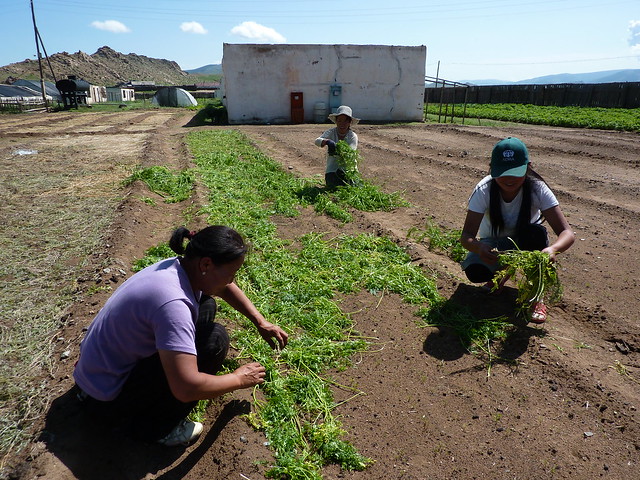
KNOWLEDGE WAS TRANSFERRING BY DAY 2 OF THE PDC.
DEAD WEEDS, PREVIOUSLY SLASHED AND REMOVED FROM THE SITE,
WERE BEING COLLECTED TO BE USED AS MULCH, CYCLING NUTRIENT BACK INTO THE SYSTEM,
RETAINING SOIL MOISTURE, AND IMPROVING SOIL QUALITY OVER TIME.

---------------------------------------------------------------------
Postscript:

It’s now been four months since I got back from the Mongolian Permaculture Project, and I am currently living in an entirely different place (Hamburg, Germany), and working on new and different projects; but that, my friends, is another story for another day.

Right now we’d like to tell you about an opportunity to make your dreams [however weird] of working internationally as a permaculture aid worker come true:
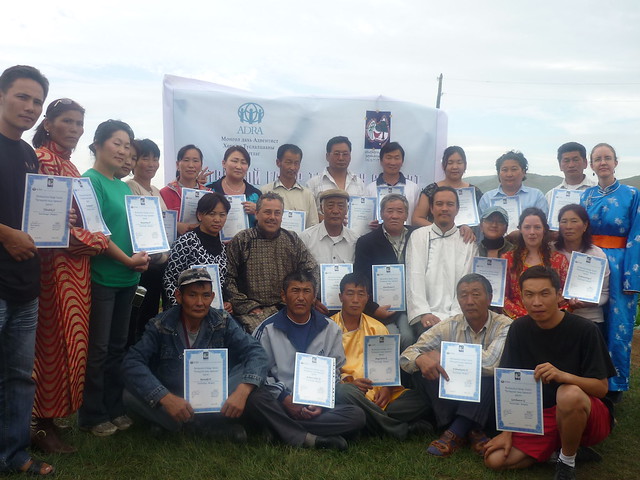
GRADUATING CLASS OF MONGOLIA'S INAUGURAL PDC CLASS OF 2010.
The Australian Youth Ambassadors for Development (AYAD)[xxxiv] and ADRA Mongolia[xxxv] are looking for a suitable candidate for an expenses-paid, 12 month volunteering opportunity, in conjunction with AYAD and ADRA.  The successful candidate must be under 30 years of age, and have minimum qualification of Permaculture Design Certificate[xxxvi] or equivalent diploma / certificate in related field [such as Horticulture, Ecology, Agronomy, etc].

The official position title is Food Security Technical Officer, specialising in permaculture and organic gardening”.

Duties will include: “assisting to teach refresher courses to Food Security Staff in permaculture principles and practice, developing appropriate permaculture manuals, conducting field assessments to community gardens, and providing technical advice and research on implementation of identified permaculture practices in the Mongolian context.”

The successful candidate will report to ADRA Mongolia’s Food Security Director, who is a PDC graduate with a background in agronomy and hydro-engineering.

You’ll have to be quick though, applications for the position close on January 19th, 2011 …share this article and help spread the word to anyone else you think might be qualified and interested!

Contact me, or ADRA Programs Director Michelle Abel, for more information and to get your application started.


Hyperlink index:
[i] Geoff Lawton’s ‘Through the Eyes of Permaculture’ 2:00 youTube video
[iii] permaculturePrinciples.com ‘Small and Slow Solutions’
[viii] ‘The End of Poverty’ documentary film trailer
[ix] permaculture.org.au 'Geoff Lawton's Greening the Desert' 5:20 youTube video
[xii] Rick Coleman’s ‘Why We Teach Permaculture' 1:58 youTube video
[xiii] Bill Mollison’s ‘Global Gardener: Bill talks about his garden' 6:36 youTube video
[xv] Rick Coleman’s ‘Sheet Mulch Gardening in the Deserts of Mexico' 5:07 youTube video
[xxii] Michael Green, freelance journalist on ‘Permaculture'


Sunday, August 8, 2010

Mongolian Permaculture: Day 40 - Resource Inventory [Erdene Permaculture Short Course: Day I]


THE GOBI: FULL OF EMPTY

Our visits to the various Co-Operatives and Zamiin Yyl have given us an opportunity to conduct a Resource Inventory, to identify areas of greatest need where we can make the biggest impact in the short time we will have to work with the Co-Operative leaders and Members who have been selected to attend the Gobi training.

The Resource Inventory is a formal tool created by David Holmgren [with input from Ian Lillington, author of ‘The Holistic Life’], and is like a SWOT Analysis for Permaculture Designers …and anyone working in Sustainable Aid.

Really, it’s just a written version of what I have watched Rick do unconsciously since the moment we stepped off the plane:


Stage 1, Observation: What do we have to work with right now?
  
    Take inventory of all available resources, including Landscape, Infrastructure, Household, and Culture
Stage 2, Evaluation: What can it be used for?  


    List all possible functions of available resources.
Stage 3, Strategy: What can we do with it?  


    Explore possible ways to harness, use, and direct available resources.
Stage 4, Design: How can we connect it?  


    Explore possible ways to connect strategies create energy cycles and maximize multi-functions.
Stage 5, Implementation: Who? What? Where? When? How Much?


    Explore logistics and practicalities towards putting strategies and designs into effect right now.

Stages 1 and 2 are like a massive information gathering / brainstorming session and can be done with just initial team members; we spent the first two weeks of this trip doing just this.

Stages 3 – 5 can only be effectively done with input from local stakeholders; this local knowledge and skill base is the biggest asset a Sustainable Aid Worker has. 


By working with what is already locally available, resources can be re-organized into design solutions that can be easily adopted, adapted, and evolved by communities.

Similarly, knowledge can be more easily transferred and new skills more readily developed if they are culturally appropriate.

GOBI HASHA,
TAKEN FROM TOP OF PASSIVE SOLAR GREENHOUSE

Communities take ownership in ideas they have come up with for themselves, and teaching concepts rather than lecturing formulae & information will empower & encourage individual thought experimentation within a sustainable design framework, supporting forward movement and problem-solving without the need for constant supervision & trouble-shooting.

A positive feedback loop is created, and learning curves accelerated because students now have a holistic design framework in which to observe, ask the right questions, then filter and organize information through this base foundation.

Risk is managed through careful thought, and informed, small-scale implementation in experimental plots. Mistakes are confined to these smaller areas [rather than risking an entire crop], and become stepping stones to learning:
  1. What worked?
  2. Why did this work?
  3. What didn’t work?
  4. Why didn’t this work?
  5. How can we improve?

When designing a course for a new culture, or as in this context, for a different community within a culture, this process of:
  • Constant gathering of information
  • Evaluating what can be done with available resources
  • Strategizing potential uses [through observation and asking questions of locals]
  • Designing appropriate solutions
  • Small-scale experimentation [also through observation and asking questions of locals] before implementation

...allows the Permaculturist to create a course customized to the available teaching timeframe, and the most immediate needs of the students.

DORNOGOBI'S INAUGURAL PDC CLASS

--------------------------------------------------------------------------------


Gardening in the Gobi Desert Co-operatives’ Short Course Outline:

Day 1:
1. Breakfast Session: Introduction, Housekeeping, Principles [Multi-function]
2. Morning Tea Session: Ethics, Observation Walk
3. Lunch Session: Principles [Energy-efficient Planning]
4. Afternoon Tea Session: Integrated Pest Management

Day 2:
1. Breakfast Session: Principles [Small-scale Intensive], Soil – Kat, Rick
2. Morning Tea Session: Maximizing Vegetable Crop Production –Rick
3. Lunch Session: Compost Prac - Rick
4. Afternoon Tea Session: Resource Inventory - Matt

Day 3:
1. Breakfast Session: Bees & Worms - Kat
2. Morning Tea Session: Chickens - Rick
3. Lunch Session: Micro-climates and Greenhouse Design - Rick
4. Afternoon Tea Session: Water & Trees - Rick

Day 4:
1. Breakfast Session: Water, A-Frame Prac - Rick
2. Morning Tea Session: Seed-Saving - Kat
3. Lunch Session: Food Culture - Kat
4. Afternoon Tea Session: Vision Plan - Rick


CHILDREN OF THE GOBI:
THE REAL RESON WE ARE HERE.


Thursday, August 5, 2010

Mongolian Permaculture: Day 37 – Sainshand Aimag Center, and What To Do When Two Bulls Are Charging

...I FOUND THE FOUNTAIN IN THE PICTURE,
BUT NOT THE DINOSAUR...


The day dawns bright and sunny, the stark desert light streaming through our window.

Breakfast is a fried egg on a fried slice of bread in the restaurant, and we are very happy to see that our translator has at last shown up!

Things are looking up, we catch up with Minde and review our plans for the trip, including the new plan to visit our friend The Guv.

We walk out to the main road and flag down a taxi – in Mongolia, anyone can decide to be a taxi and pick you up – and soon a car slows down, kicks out the old man sitting in the back seat, and offers to take us out to the co-operative.

THIS PIPE TAKES WATER FROM THE WELL
USING A PETROL-POWERED PUMP
TO IRRIGATE A POTATO CROP PLACED AT THE TOP OF THE HILL IN THE DISTANCE

This group is struggling more than any we’ve seen the entire trip; as we walk around the fields, Rick and Kat both wonder aloud if they’ve got any livestock, because there certainly will not be enough vegetable crops produced here to feed one family, let alone all the families of the co-op.

FLOOD IRRIGATION IN POTATO FIELDS:
SALT IN THE WATER TABLE IS LEFT BEHIND AS IT EVAPORATES,
EXACERBATING THE SALTING OF THE SOIL WITH EACH WATERING.
SUBTERRANEAN DRIP IRRIGATION IS MORE APPROPRIATE IN THESE CONDITIONS
TO MINIMIZE WATER LOSS TO EVAPORATION AND THE RESULTANT
COMPOUNDING SALTING EFFECT.

Salty soils, windblasted crops, a petrol pump hammering away loudly in the background …melon crops shriveling …a massively overengineered rock pyramid to elevate the water tank …which has water being pumped to potato crops being flood irrigated at the top of a hill …moth-eaten cabbages struggling under the relentless sun …a recently built root cellar sitting empty and unused, its clay floor soggy from water running off into the front door…

WILD RHUBARB GROWING AS A 'WEED'
IN THE SALTY POTATO CROP IRRIGATION CHANNELS

Meanwhile, wild onions and wild rhubarb grow throughout, thriving on neglect and almost taunting the farmers with their spontaneous growth.

SUCCESSFUL CHILI CROPS IN THE GREENHOUSE

It’s all a bit depressing, until we reach the greenhouses… and find that the group has achieved some real success with their tomato and cucumber crops. It is a relief for us all, and it is apparent that this co-operative has been figuring out for themselves that their input-output ratio is far better in these small, intensively managed spaces.

AN UNDERGROUND COOL ROOM IN THE MIDDLE OF THE DESERT...
...HMMM, WHAT OTHER FUNCTIONS CAN WE GET OUT OF THIS INVESTMENT IN INFRASTRUCTURE?

To permaculture eyes, some solutions seem very obvious: for a permaculturist, it is almost painful to see an un-used resource in any system.

For example, having a root cellar sit un-used for 3 months /year would just be too painful to bear; instead, why not run a wire from the bank of solar panels near the water tank to the cellar for light and power, and live out the hot Gobi summer months in cool underground comfort, and utilise this resource throughout the year?

GREENHOUSE PRODUCTION FAR OUTWEIGHED
ACREAGE PRODUCTION AT THIS CO-OPERATIVE

Windbreaks, mulch, drip irrigation, crop stacking, and better greenhouse design will all improve production here, and we are beginning to question the wisdom of deciding to grow cabbages in an area where they are clearly not suited to.

The sheer amount of energy required to maintain this crop in the Gobi, let alone create conditions in which it can flourish, would simply be unsustainable. Perhaps a better place to start [and more efficient use of energy] would be to look at plants adapted to, and already growing in the region – such as the wild onions and rhubarb - then exploring their viability as food and cash crops.

It is much easier to work with nature than to fight against her.

After lunch and a mid-day siesta [seeking shelter from the Gobi wind and sun], we flag down another car/taxi to visit the food processing facility across town.

THE TWO BULLS APPROACH EACH OTHER OUTSIDE THE FOOD PROCESSING FACILITY

Minde
and I arrive in the car behind Rick, Kat and Oyuna, and the tensions which have been simmering since Minde’s failure to make the train ride down with us suddenly erupt.

We’ve been effectively hamstrung in our effectiveness for the last two days, and Rick’s frustration finally boils over.

Minde is a proud man himself, and does not appreciate the verbal lashing, so the Two Bulls butt at each other for a while [one threatens to leave the project to work where he might be better appreciated, while the other threatens to find a replacement translator], and we all clear the room while they sort it out.

Nothing violent, just two very strong, very smart men arguing loudly, until at last a resolution is found, and they emerge shyly to continue with the site visit.

Rule #1 of Conflict Resolution:
‘Never get in the way of Two Bulls charging.’
- COMMON SENSE -

Kat takes over with questions for our host, and we are shown the autoclaves, jar storage sheds, and brand-new vaccum packaging machines.

GOBI GOODIES

There is even a package of preserved wild onions in a chilli sauce, which has proven to be a popular seller in local markets. This may be the evidence we need to support the idea of growing local plants as cash crops in the Gobi.

Back at the hotel, the two men shake hands and bury the hatchet, laughing at the day’s events. Aid and Development is not easy work, and both men know the emotional toll it can take.

More importantly, both men know that the work to be done is far more important than emotional overload, or wounded pride.

Tomorrow we will catch the train to Zaimin Yyl to meet the Deputy Governor.


Wednesday, August 4, 2010

Mongolian Permaculture: Day 36 - Dalanzargalan, Sainchand, and the Governor of Zamin Yyl

WELCOME TO THE GOBI

The sand-blasting wind which greeted us late last night did not let up.

On
his first visit to the Gobi Dessert, Rick boldy predicts rain today [upon arrival, and after midnight] ...and the co-operative members who came out to greet us at the railway station shake their heads ‘No’ in amusement.

‘Don’t be silly; we’re in the Gobi…’

…this morning, however, the wind dies down as breakfast is brought in, the first drops of rain spattering against the window as the co-operative members who thought Rick was crazy last night are wondering if perhaps this strange man with the bright yellow shirt and loud red hat has brought rain to the Gobi.

THERE'S 3 MORE OF US IN THIS CAR!

We cram ourselves into the back of a tiny sedan and bounce out to the vegge plot, wedged into the back seat so tightly that dips which otherwise would have sent us crashing into the ceiling are rendered mere bumps along the way.

Jackets and beanies today against the cold and wet, sandy soil sticking in clumps to our boots due to the higher clay content here.

LOOK CLOSELY AND SEE IF YOU CAN PICK OUT ANY GEMSTONES...

The ground is also littered with rocks: quartz and ironstone and an outcrop of shale or perhaps slate and something that looks like amethyst, and something else that might be flourite.

RICK AND KAT WALK THE SITE

The co-operative plot is located in the middle of a windy, open desert plain, and the crops are windblasted throughout.

A Chinese mine can be seen in the near distance, their closest neighbour, though because our translator still has not arrived, we are unable to determine exactly what they are mining… if it is coal, than we may have access to coal dust, a waste product of the mining operation that could be used as a slow release mineral fertilizer for the cropping fields.


Three year old seabuckthorn trees are healthily established but stunted, and Rick plucks out a woody shrub growing nearby, walks over to the perimeter fence, and weaves it into the wires to demonstrate how to form a windbreak.

1. UNSHELTERED BEETROOT PLOT

2. WIND-SHELTERED BEETROOT PLOT

The beetroot plots are sparse, except for a patch nestled in a corner formed by the solar panels’ battery house and the water tank, forming an unintentional windbreak which demonstrates what a dramatic difference the simple adjustment of keeping the wind off can make.

DESERT WEED SUITABLE FOR 'LIVING MULCH' GROUND COVER;
WINDBLASTED AND STUNTED SEABUCKTHORN SAPLINGS CAN BE SEEN BEHIND RICK

The desert weeds spring up pretty quickly once fences are up to keep the grazers off, and we identify one groundcover desert species that is thriving in the harsh conditions [now that the animals are unable to munch on it] that would make a great living mulch.

THE GOOD NEWS :
WORD TRAVELS FAST -
ONE WEEK AFTER LEARNING ABOUT MULCH IN TOSONTSENGEL,
THIS NEW KNOWLEDGE IS TRANSFERRED AND REPLICATED
THOUSANDS OF MILES AWAY IN THE GOBI DESERT


Kat is scribbling notes and I am snapping pictures furiously to keep up with Rick’s running commentary and analysis of the site so that we can fire questions at our translator when [and if] he arrives.

WIND DAMAGE VISIBLE TO FRAME ON RIGHT [WINDWARD SIDE] OF TOMATO GREENHOUSE

The greenhouse crops are doing well here, with the first red tomatoes we have seen on the vines all trip, just now ripening. However, the steel frame of the tomato greenhouse is visibly buckling from the stresses on its winward side and the plastic is beginning to rip in the corners; there is room for further improvement here.

SUCCESSFUL CUCUMBER CROP IN DOUBLE-GLAZED, SUBTERRANEAN GREENHOUSE

The cucumber greenhouse has been built into the ground, has an insulative double-layer of plastic sheeting, and a cage rock wall on the south-facing side of the north wall for thermal mass. The co-operative leader plucks a couple large cucumbers from the vines and offers them up for us to munch on as we continue the site visit.

MELON CROP LOOKING DISMAL

Spray irrigation is being used in the melon field, which exacerbates salination in the salty soils, and maximizes water loss to evaporation in the desert conditions. Indeed, the melon crop is looking dismal and will not yield any notable crops.

POTATO CROPS IN TOSONTSENGEL WERE ALMOST TWICE THIS SIZE,
AND ALREADY FLOWERING

Similarly, the potato fields are looking pretty sparse for this late in the season, and these are being flood irrigated instead. This also has the effect of exacerbating salination; as surface water evaporates, a salty film is left behind which compunds each time the trenches are flooded. Over time, the salt will build to unsustainable levels for cropping.

Trenching and mounding could also be done more efficiently here – mound, mound, trench instead of mound, trench, mound – to reduce labour inputs, and increase productivity.

THIS IS NOT A ZUCCHINNI!
[C'EST NE PAS UN MUSHROOM]


We are shown a fairly healthy zucchini crop that makes a sound like knocking on wood when we rap our knuckles on it; it turns out to actually be a variety of winter squash ...could be good for storing, some squash varieties will keep for up to six months.

WEAVING A WINDBREAK INTO PERIMETER FENCING
USING WILD DESERT SHRUBS GROWING IN FENCED AREAS


Then we all huddle into the solar panels’ battery room to get out of the rain and warm our hands and bodies with a nice warm cup of tea; time for a quick training...

DALANZARGALAN CO-OPERATIVE

…except that our translator is still missing…

…frustrated and full of unanswered questions, we pile into the back of a hand-cranked tractor and are taken back to the hotel to catch our 4pm train to Sainchand.

TRACTOR RIDE IN THE GOBI DESERT ...PRICELESS.

Sainshand is the largest aiymag [rural center] we have been to outside of Ulaanbaatar, with a population of approximately 37,000.

Its large train station is on the edge of town, and is a hive of activity, while the wind continues to whip us even as we shuffle towards the taxi stand in search of a ride to town.

As the muted light fades from the overcast twilight shy, our hotel lobby welcomes us in darkness as we stumble up the steps into the double doors.

There is a tense moment of uncomfortable silence as the startled receptionist tries to renegotiate the room rates - to double the price - when she sees our foreign western faces walk in the door.

We turn on our heels and march back out into the wind, and a staff member hurries after us to bring us back at the original rate – 20,000MNT
[approx $20AUS] /night.

When the electricity is finally turned on [after eating the first half of dinner by LED flshlight], we find ourselves in the swankiest accomodation we've experienced yet. The hotel restaurant is decorated like a rich ger, hung with paintings of Mongol horsemen, archers, scenes of nomadic life, the obligatory portrait of Chinggis, and exotic portraits of half-nude Mongolian women lounging seductively in the royal ger.

Since we are no longer on official Aid Agency business, we try to order a cold beer, and find out that it just so happens that today is a ‘no alcohol’ day in this particular aiymag center. It seems that each time we try to go out for a cold beer, we time it so that it co-incides with a TOTAL BAN day…

…the first night in Ulaanbaatar, before we began the consultancy, we tried to sample the Chinngis beer on tap, only to be told that alcohol wasn’t served on Thursdays in Mongolia. Then, thirty days later, when we try to have a celebratory cold one for a job well done at the conclusion of the consultancy, we just so happen to go out, again, on a TOTAL BAN night:

"But it’s not Thursday,” we protest, and find out that, actually, every 1st of the month is a TOTAL BAN day in Ulaanbaatar.

Now, 4 days later, we find out that we have wandered into Sainchand Aiymag Center on the 4th of the month, which, of course, just so happens to be a TOTAL BAN day. Some Aussies have all the luck.

Rick wanders over to one of the exotic portraits in the corner of the restaurant to appreciate it from a better angle, and an important-looking gentleman in dark glasses glances up from his beer with a look that says, ‘What the hell do you want, mister?’

To which Rick smiles and says, ‘Sain Bain O! [Hello!]’

The important-looking man drinking the only beer in town on a TOTAL BAN night looks over his dark glasses, pauses for a few moments, then laughs heartily and waves us over to join him.

A couple cold Chinggis Drafts later, it turns out that we have made friends with the Governor of Zaimin Yyl, a soum located another three-hour train ride south from Sainshand to the Chinese border. He graciously invites us to visit his soum on our day off, promising camel rides and horse rides and good times, in exchange for a visit to his local vegetable-growing plot.

"Why not?", we shrug to each other, and it is settled, on Saturday we will go to visit our new friend.

It's easy to make new friends in Mongolia!