Showing posts with label Mongolian Permaculture. Show all posts

Monday, April 4, 2011

Lessons learned from Investment bankers and Brazillian billionaires (Day 23)

Bek-doc-matt
Photo: (L to R) - Tilyeubek Ye (ADRA-Mongolia), Matthew Lynch (The Asia-Pacific Center for Regenerative Design), and Dorgsurren 'Doc' Khoo (ADRA-Mongolia), at sunrise on the Barrens of Bayan Ulgii.

One of the first lessons I opened up our class on Regenerative Business was this: Never trust an Investment Banker.

I may have to retract that statement and make an exception; good Investment Bankers, ones with functional consciences even, do exist (and, I might add, could be worth their weight in gold).

Thanks to my beautiful new Kazakh fox hat (a gift from the graduating class of Bayan Ulgii's inaugural Permaculture Design Training course), and a strange twist of fate, I find myself sitting next to half of Mongolia's Mexican population on the plane to Beijing, a casually dressed, elegant young man by the name of Oscar Mendoza, who also happens to be the COO of Mongolia's first boutique investment bank: Frontier Securities (Frontier assisted with the first  IPO of a Monoglian-owned mining company, possibly creating Monoglia's first member of the Forbes 400 List and paving the way for other Mongolian companies to follow suit).

Apparently, there's no better icebreaker than a big fluffy hat which looks like an animal has wrapped itself around your head, because Oscar is impressed with the spectacle of my attempts to stuff the oversized furball into the overhead compartment above his seat, and we strike up a very interesting, and diverse conversation ranging from mining, agriculture, NBA All-Star weekend, the foreign investment climate in Mongolia, our respective homelands, Robert Kiyosaki, our current projects, Bank of -Evil- America, former Bank of America employees we know who are now involved in charitable work to atone for their time spent working for Bank of America, sustainable economic development, the amazing potential of the human mind, tsu-te-tse, and oh yes (I told you it was a diverse conversation): Regenerative Business.

Mexican_in_mongolia

Photo: Oscar Mendoza, half the current Mexican population of Mongolia and Co-COO of Frontier Securities.

I'll spare you the details of our rather schizophrenic conversation (which I can assure you, made perfect sense to the both of us, and was highly entertaining, even if only to ourselves), and share a quick story that Oscar told me about one of his billionaire acquaintances:

Our conversation stumbled onto the topic of Robert Kiyosaki's definition of an asset: something which feeds you.  Oscar Mendoza, (who must be at least somewhat financially savvy to have landed a job which requires him to work on deals containing so many zeroes the numbers sound nonsensical, almost Suess-ical), Co-COO of Mongolia's first and finest boutique(i) Investment Banking firm, commented: By the way I agree with Kiyosaki, even though every bank will probably tell you otherwise.

He went on to tell me about his billionaire acquaintance, a very wealthy and ambitious, self-made Brazillian man who runs one of the world's largest Oil and Natural Gas companies (OGX).  This man makes no secret of his desire to become the world's wealthiest man, and in the course of his dealings one evening, Oscar took it upon himself to suggest to gentleman that it might be quite a task to knock of the Mexican gentleman who sits above him on the Forbes 400, a billionaire who made his fortune in Telecom - he would be pretty difficult to knock off because his business model basically requires him to do little more than sit back and collect his revenues, now that the money has already been spent on building the infrastructure which runs everything.

In comparison, the Oil Business requires huge amounts of money to research & discover a viable oil field, then even more money to develop & tap the field to create productive wells, and more money to extract, refine & deliver the final products. 

The Brazillian billionaire smiled, leaned in a little closer and said I'll tell you my little secret: 

When I want something to happen, every night before I go to bed, I spend 30 minutes in my thinking room, where I think in detail about exactly how everything will look when it's done.  They said I couldn't build the largest shipping port in Brazil; but I did.  They think I'm superstitious and crazy, and can't believe that it could possibly be so simple.  They say I can't be the richest man in the world; we'll see.  But I tell you this: my simple little secret, it works.

So there you go.  Maybe it really is that simple: Think, and grow rich.

To think is to create. 

Thoughts are things. 

Mind over matter. 

We get what we focus on.

However you want to phrase it; think I'll give it a try.  ...I'll let you know how it works out.

Sneetches_star_off_machine
 But McBean was quite wrong. I’m quite happy to say.
That the Sneetches got really quite smart on that day.
The day they decided that Sneetches are Sneetches.
And no kind of Sneetch is the best on the beaches.
That day, all the Sneetches forgot about stars and whether
They had one, or not, upon thars.
   - From Dr Suess' 'The Sneetches' -


Oh, and in case you were wondering... the man he was telling me about, the Brazillian billionaire? 

His name is Eike Batista.

Look him up - maybe you can even try out his little secret for yourself.


__________________________________________

(i) Unlike the big boys (Goldman Sachs, Lehman Brothers, Merril Lynch and the like), employees of most boutique investment banking firms live and work in the communities they serve, and therefore have an additional layer of accountability which simply isn't present with the big boys; when you live and work in a community, relationships are at stake, and you are physically present to deal the consequences of your actions, for better or worse, face-to-face. 

Sunday, March 27, 2011

Mongolian Permaculture: What's next? (Day 22)

Theme song of the day: 'Just Breathe' by Eddie Vedder.  His lyrics just couldn't say this any better.

Scpi_pdc_09
Photo: graduating class of Dec 2009 PDC at SCPI

It's been about 15 months since I stumbled across permaculture at Rick and Naomi Coleman's Permaculture Design Course at the Southern Cross Permaculture Institute in Leongatha (Victoria, Australia).

I had run out of money, moved back home with my parents in Melbourne, and, in search of what was next for me in the adventure that is my life, I had applied for a position studying Landscape Architecture at RMIT University in Melbourne.  There was no way of knowing on day one of my PDC that in just over a year, I would have been to Mongolia twice, covering an area from the Gobi Desert in the south to Zavkhan province in the northwest, to the Kazakh stronghold of Bayan Ulgii in the far west; and working on projects making a positive contribution to Mongolian communities all along the way... life is strange, and unpredictable, and beautiful.
 

Pdc_dec_09_017

Photo: Bek 'The Mongolian Maniac' wrestles with Dave 'The Ghost' Gibb at Wilson's Prom during our PDC rest day.

The new humble Monoglian friend I made on that course turned out to be the Food Security Director of an international NGO, and the small pact we made over the campfire one evening (to visit each other's homelands) is growing into an international collaboration of knowledge & resources that could help vastly different cultures connect, and learn from each other.

It's Bek's turn to visit my homeland since I am 2-0 in the visit tally right now, but first he has his work cut out for him with establishing a strong foundational year for the SEAL Project, and the other permaculture-based projects he is implementing throughout Mongolia (permaculture has been integrated into all of ADRA-Mongolia's Food Security initiatives).

600 integrated root cellars, and 600 passive solar greenhouses equipped with 600 drip-irrigation systems will be built for carefully selected beneficiaries throughout Bayan Ulgii province in the next year, as part of a 4-year plan to strengthen local food security and stimulate the local economy (with microenterprises and Self-Help microfinance groups) by seeding the community with these permaculture demonstration sites and future permaculture teachers.

Bolhadt
Photo: 'Bolhadt', Project beneficiary living in Sagsay soum.  He is married, has 2 young children, has an existing root cellar installed under his house, is already farming his own worms, and has some experience growing potatoes and turnips.

Beneficiaries are screened not for their level of needs (this would be applicable to an 'aid' or 'relief' effort), but rather for their character, motivation, and potential to become future community leaders once equipped with the tools, knowledge, and opportunity to create positive, regenerative change in their own lives.  Checks and balances (such as monitoring gender-ratios and potential conflicts-of-interest) are designed into the selection process to maximize the project's potential for success.

Like all projects and organizations, the quality of results created is entirely dependent upon the quality and character of the people driving it, and based on my experience of the eleven ADRA staff devoted to this project, and the leadership & vision of Bek, Doc, and Michelle Abel (Programs Director) from ADRA-Mongolia's head offices in UB, integrity levels are high and the project is off to a very good start. 

One heartfelt conversation I had with project staff in the closing days of the course revolved around my personal experience of how many friends came forward to support me emotionally, practically, and even financially while I watched the small fortune I made during my twenties be taken away; when the money was gone, all that was left was the people I had touched - and I was humbled to find out how many that is, and how rich I truly am.

The SEAL Project staff have a similar opportunity, in that the work they are being paid to do over the next four years will touch many lives and forge many relationships that would be challenging to create outside of this context; if project staff focus on taking care of their people the best way they know how, than each one of them will be richer than they can imagine by the time the project ends - and we are talking about true wealth: the wealth of rich and supportive relationships, not the transient & deceptive wealth of money.

Bastama
Photo: Bastama School Gardens project.

Dr. Beket's Bastama School Gardens project has the potential to impact an additional 500 students and families, while Guliya's large-scale fruit & vegetable production plot could also impact countless more.  In this way, we plant the seeds of permaculture design with 13 students, and watch it grow to help over 1,100 families move towards a sustainable & regenerative future.

As for me?  Well, I couldn't have done any of this work if not for the foundation laid by the many permaculturists who have gone before me, especially the work done by Rick Coleman and Kat Lavers during the 2010 Mongolian Permaculture project; had it not been for that experience and learning curve, I would not have a strong enough baseline of knowledge & experience to be effective here, and in fact it would have been irresponsible to send me in lieu of a more experienced instructor.

Rick_n_kat

Photo: Rick and Kat, Mongolian Permaculture 2010

I was able to be effective in Mongolian conditions, and adapt the lessons I learned last year to Mongol-Kazakh culture, only because of the time, money and effort dedicated towards skilling up, and learning from others who were so willing to share with & teach me.  Now I have a stronger baseline to operate from when working in Sustainable Aid and Overseas Development, but there are knowledge & experience gaps (especially in creating and cultivating my own productive & functional crop systems) that I need to fill.

Bill Mollison said it best in the Global Gardener series:

'Once you've set up your home, so that you can leave it for 2 or 3 months and it just gets better, so that you are free to travel, then you can go and teach other people.' 

- Bill Mollison -

So that's what is next for me:  return to Hawaii, marry the woman I love, put some roots down, and start growing some veggies. 

Come visit if you are in the area.

Wind_n_light
Photo: Wind & Light ride in Hawaii.

Home
Photo: HOME.


Friday, February 25, 2011

Regenerative business v1.0 [Bayan Ulgii SEAL Project 2011]

Draft 1.0, 'Fundamentals of Regenerative Business' learning module for SEAL Project 2011.

This session will be taught to Heads-of-household Beneficiaries and ADRA-Mongolia Field Staff, to lay the foundational understanding of creating and running a business which strengthens its community by cycling energy and money into its local markets.

Concepts are presented and explained via slideshow & lecture, then will explored and discussed during subsequent group activity, in which students will design their own Self-Help Group or Credit Co-operative Enterprises.

The final version will be translated into Russian, as the Kazakh residents of Bayan Ulgii are fluent in this language from 'Socialism Times' (as locals refer to the Soviet regime).

image: Permaculture Principles applied to Business Fundamentals.

Wednesday, February 23, 2011

Pattern literacy: Bayan Ulgii SEAL Project 2011 v1.0

Photos and imagery of local examples provide discussion points to explore how pattern literacy can be utilized to inform the design process.

View the complete presentation here.

Wednesday, January 5, 2011

A Beginner's Guide to Working in Sustainable Development

[Note: this post originally appeared on the PRI's website, and is reposted here with the hyperlink index included at the end of the article.  There are many valuable references linked to throughout the piece, which may be more conveniently accessed after you have read the article in its entirety.]


We can change the world.  We’ve all felt it, that overwhelming urge which every permie gets when they graduate from their PDC, that burning desire to share our excitement, to spread the good word, to let the rest of world in on the little secret we’ve just discovered: “WE’VE GOT SOMETHING HERE THAT CAN REALLY HELP US ALL, IF YOU WOULD ONLY JUST LISTEN!!”[i]

And it’s true.  We are on to something.  We really can solve all the world’s problems in our gardens.[ii] 

Though before we beginners rush out to save the world, it is important that we step back, slow down[iii], take a brutally honest look at ourselves, and identify the gaps in our experience, knowledge, abilities, and skill-sets that we need to fill - before we take the plunge of working in international aid.

The old saying goes: “The road to hell is paved with good intentions,” and this is especially true when it comes to foreign aid.  Listen to any seasoned permaculture aid worker[iv] long enough, and they are bound to tell you dozens of frighteningly embarressing stories[v] of well-intentioned aid gone wrong, or at least being less effective than they could have[vi].

After completing my 72-hour PDC at Southern Cross Permaculture Institute (SCPI)[vii] in December 2011, I was eager to rush out and do my part to help end poverty[viii].

After all, I have ten years of experience in small business, taught finance and real estate all over the State of Hawaii, and was able to make a lot of people a lot of money back in the days when I ran my little firm[xi].  Surely, I told myself, I had something to contribute?

RICK'S DAILY COMMUTE TO TEACHING
THE PDC IN NEPAL, 2001.
So I asked Rick Coleman[xii], who in his 18+ years teaching permaculture has worked in some of the harshest conditions, on every continent [except Antarctica], with some of the poorest people in the world, if I had what it takes to work in Overseas Aid and Development. 

His answer was direct, painfully simple, and borne from the frustrating perspective of bearing witness to countless aid agencies inadvertently making mistakes – and risking countless lives – in well-intentioned, but ill-informed efforts to make a difference:

“Have you ever grown enough food to feed your family?”

Erm, hmmmm, uhhhh…..Right.  Good point.  He had me, and he knew it; and he went on to say:

“When we work in the developing world, the stakes are very high: if you make a mistake, someone goes hungry, someone cannot feed their child that day.  We must design carefully to avoid precarious situations, or we are taking extreme risks with people’s lives.”
-Rick Coleman-


“Once you’ve set up your own home, so that you can leave it for 2 or 3 months and it just gets better, so that you are free to travel, then you can go and teach other people.”
  - Bill Mollison -

Then, perhaps sensing that in three short sentences, he may have crushed all of my hopes and dreams for ever working internationally, Rick planted a seed:

“You can build upon your strengths and experience in business and finance, take that and translate it into permaculture aid.  For example, microfinance and enterprise development could become your core strength in this field.” 

“You can grow into an effective teacher, though first you’ll need to study the pedagogy of how to teach permaculture - it’s one thing to tell, and quite another thing to teach.”
-Rick Coleman-

…and so seven months later I wake up in a ger [yurt], my belly in knots[xiv] from too much tsu-te-tse [traditional salty milk tea] drunk the night before, and dash outside, into the achingly cold morning and over to the pit latrine at the edge of the hasha [family compound], which has been dug barely high enough so that I can avoid embarrassing splatters - if I can only squat deftly enough.

CLASS PHOTO IN ZAVKHAN PROVINCE, NORTHWESTERN OUTER MONGOLIA
I’ve spent the last six months living and working on Rick’s farm: shovelling shit into no-dig garden beds[xv], wheeling wheelbarrows around landscaping projects[xvi], swinging a hammer[xvii], slinging strawbales around houses made of natural and recycled materials[xviii], loving every mud-splattered minute of it and doing all I can to learn and skill up, and somehow be helpful enough to justify a spot on the team for his next overseas consultancy…

…and now, I am waking up in the Outer Mongolian province of Zavkhan, supporting a Sustainable Aid consultancy for ADRA Mongolia[xix], who has sponsored us to teach the country's first-ever Permaculture Design Course[xx], to the nomads whose herds had been decimated by increasingly harsh winters.

Rick’s team includes Kat Lavers [of Transition Towns Darebin[xxi] and The Plummery Urban Permaculture Demonstration Site[xxii] in Melbourne], a young though experienced permaculture teacher and activist, and, well …me.  Bek[xxiii], my good friend and PDC classmate is also there, because he is a native of Mongolia, and also happens to be the Director of Food Security for the NGO – who have done a good job in laying a foundation for permaculture to become well-integrated into their design solutions and operations by investing in their staff’s Permie-powers.

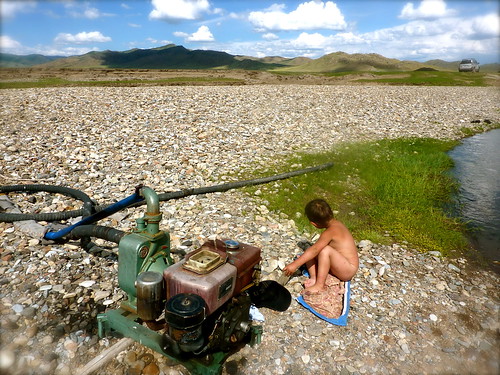
PETROL PUMPS, PREVIOUSLY CONSIDERED TO BE AN ASSET, WERE RE-CLASSIFIED BY STUDENTS
 FROM A PERMACULTURAL PERSPECTIVE AS A LIABILITY IN FAVOUR OF RAM PUMPS,
WHICH HAVE ONLY TWO MOVING PARTS AND HARNESS THE RIVER'S FLOW
TO PUMP WATER UP TO THE GROWING PLOT.
You should try gardening here:  -40 C winters, ancient beach sand for soil[xxiv], super short growing season, and little access to water.  Some co-operatives are watering 20 plus acres by hand[xxv], and apart from that Mongolians don’t even like to eat vegetables – they’ve never had the luxury of being able to choose a vegetarian diet. 

I am glad that I heeded Rick’s advice, took time to build my Permie-powers, and then found seasoned, successful teachers willing to take me under their wing; this way I gain invaluable on-the-ground experience that cannot be gleaned from a website, classroom or two-week course [no matter how intensive].  I am able to collaborate on design solutions, make attempts at reading the landscape[xxvi], and bounce ideas around within the safety net of my more experienced companions.

Most importantly, this minimizes the chances that I will make any beginner’s mistakes[xxvii] that could cause a family to go hungry.

“A Permacultural System looks at designing for the extremes.  Especially when working in aid, we design first for Survival, then Subsistence, then Self-Sufficiency, and then Abundance of Harvest [where crops can be bartered or given away].  Finally, we can move on to Commercial production.”
  – Rick Coleman –

My primary role here is to support the other two, and document the project with photos[xxviii], video[xxix], and a daily blog[xxx] that we can use as a teaching tool for other permies wanting to develop the experience, knowledge and skills necessary for working effectively in Permaculture Aid. In true multi-functional-permie-fashion, I’ve also arranged with my AQTF, nationally accredited T.A.F.E. level Permaculture Diploma [xxxi] Instructor that my blog can do double-duty and count towards my assessment tasks in the course.

My secondary role is to assist in setting up and conducting any practicums, like building a compost heap[xxxii] or any of the other fun learning activities every permie gets to do on their PDCs.  Then, the best surprise ever: in week four of the project, Rick works with me and draws from my experience to develop a lesson plan for the session on Microfinance; then he asks me to teach the session, and all of a sudden I am teaching business and finance to the descendants of Ghengis Khan’s fearsome army[xxxiii].

Dreams, even the really weird ones, really do come true.

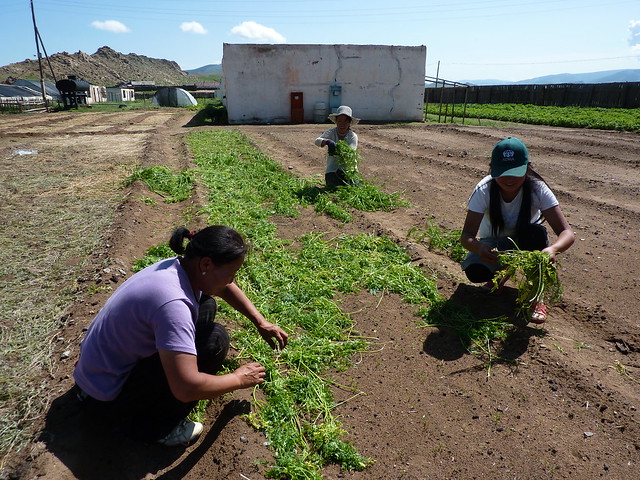
KNOWLEDGE WAS TRANSFERRING BY DAY 2 OF THE PDC.
DEAD WEEDS, PREVIOUSLY SLASHED AND REMOVED FROM THE SITE,
WERE BEING COLLECTED TO BE USED AS MULCH, CYCLING NUTRIENT BACK INTO THE SYSTEM,
RETAINING SOIL MOISTURE, AND IMPROVING SOIL QUALITY OVER TIME.

---------------------------------------------------------------------
Postscript:

It’s now been four months since I got back from the Mongolian Permaculture Project, and I am currently living in an entirely different place (Hamburg, Germany), and working on new and different projects; but that, my friends, is another story for another day.

Right now we’d like to tell you about an opportunity to make your dreams [however weird] of working internationally as a permaculture aid worker come true:

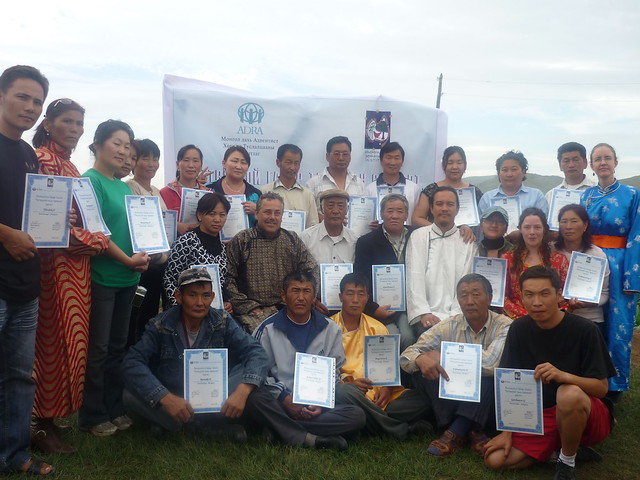
GRADUATING CLASS OF MONGOLIA'S INAUGURAL PDC CLASS OF 2010.
The Australian Youth Ambassadors for Development (AYAD)[xxxiv] and ADRA Mongolia[xxxv] are looking for a suitable candidate for an expenses-paid, 12 month volunteering opportunity, in conjunction with AYAD and ADRA.  The successful candidate must be under 30 years of age, and have minimum qualification of Permaculture Design Certificate[xxxvi] or equivalent diploma / certificate in related field [such as Horticulture, Ecology, Agronomy, etc].

The official position title is “Food Security Technical Officer, specialising in permaculture and organic gardening”.

Duties will include: “assisting to teach refresher courses to Food Security Staff in permaculture principles and practice, developing appropriate permaculture manuals, conducting field assessments to community gardens, and providing technical advice and research on implementation of identified permaculture practices in the Mongolian context.”

The successful candidate will report to ADRA Mongolia’s Food Security Director, who is a PDC graduate with a background in agronomy and hydro-engineering.

You’ll have to be quick though, applications for the position close on January 19th, 2011 …share this article and help spread the word to anyone else you think might be qualified and interested!

Contact me, or ADRA Programs Director Michelle Abel, for more information and to get your application started.


Hyperlink index:
[i] Geoff Lawton’s ‘Through the Eyes of Permaculture’ 2:00 youTube video
[iii] permaculturePrinciples.com ‘Small and Slow Solutions’
[viii] ‘The End of Poverty’ documentary film trailer
[ix] permaculture.org.au 'Geoff Lawton's Greening the Desert' 5:20 youTube video
[xii] Rick Coleman’s ‘Why We Teach Permaculture' 1:58 youTube video
[xiii] Bill Mollison’s ‘Global Gardener: Bill talks about his garden' 6:36 youTube video
[xv] Rick Coleman’s ‘Sheet Mulch Gardening in the Deserts of Mexico' 5:07 youTube video
[xxii] Michael Green, freelance journalist on ‘Permaculture'


Sunday, August 8, 2010

Mongolian Permaculture: Day 40 - Resource Inventory [Erdene Permaculture Short Course: Day I]


THE GOBI: FULL OF EMPTY

Our visits to the various Co-Operatives and Zamiin Yyl have given us an opportunity to conduct a Resource Inventory, to identify areas of greatest need where we can make the biggest impact in the short time we will have to work with the Co-Operative leaders and Members who have been selected to attend the Gobi training.

The Resource Inventory is a formal tool created by David Holmgren [with input from Ian Lillington, author of ‘The Holistic Life’], and is like a SWOT Analysis for Permaculture Designers …and anyone working in Sustainable Aid.

Really, it’s just a written version of what I have watched Rick do unconsciously since the moment we stepped off the plane:


Stage 1, Observation: What do we have to work with right now?
  
    Take inventory of all available resources, including Landscape, Infrastructure, Household, and Culture
Stage 2, Evaluation: What can it be used for?  


    List all possible functions of available resources.
Stage 3, Strategy: What can we do with it?  


    Explore possible ways to harness, use, and direct available resources.
Stage 4, Design: How can we connect it?  


    Explore possible ways to connect strategies create energy cycles and maximize multi-functions.
Stage 5, Implementation: Who? What? Where? When? How Much?


    Explore logistics and practicalities towards putting strategies and designs into effect right now.

Stages 1 and 2 are like a massive information gathering / brainstorming session and can be done with just initial team members; we spent the first two weeks of this trip doing just this.

Stages 3 – 5 can only be effectively done with input from local stakeholders; this local knowledge and skill base is the biggest asset a Sustainable Aid Worker has. 


By working with what is already locally available, resources can be re-organized into design solutions that can be easily adopted, adapted, and evolved by communities.

Similarly, knowledge can be more easily transferred and new skills more readily developed if they are culturally appropriate.

GOBI HASHA,
TAKEN FROM TOP OF PASSIVE SOLAR GREENHOUSE

Communities take ownership in ideas they have come up with for themselves, and teaching concepts rather than lecturing formulae & information will empower & encourage individual thought experimentation within a sustainable design framework, supporting forward movement and problem-solving without the need for constant supervision & trouble-shooting.

A positive feedback loop is created, and learning curves accelerated because students now have a holistic design framework in which to observe, ask the right questions, then filter and organize information through this base foundation.

Risk is managed through careful thought, and informed, small-scale implementation in experimental plots. Mistakes are confined to these smaller areas [rather than risking an entire crop], and become stepping stones to learning:
  1. What worked?
  2. Why did this work?
  3. What didn’t work?
  4. Why didn’t this work?
  5. How can we improve?

When designing a course for a new culture, or as in this context, for a different community within a culture, this process of:
  • Constant gathering of information
  • Evaluating what can be done with available resources
  • Strategizing potential uses [through observation and asking questions of locals]
  • Designing appropriate solutions
  • Small-scale experimentation [also through observation and asking questions of locals] before implementation

...allows the Permaculturist to create a course customized to the available teaching timeframe, and the most immediate needs of the students.

DORNOGOBI'S INAUGURAL PDC CLASS

--------------------------------------------------------------------------------


Gardening in the Gobi Desert Co-operatives’ Short Course Outline:

Day 1:
1. Breakfast Session: Introduction, Housekeeping, Principles [Multi-function]
2. Morning Tea Session: Ethics, Observation Walk
3. Lunch Session: Principles [Energy-efficient Planning]
4. Afternoon Tea Session: Integrated Pest Management

Day 2:
1. Breakfast Session: Principles [Small-scale Intensive], Soil – Kat, Rick
2. Morning Tea Session: Maximizing Vegetable Crop Production –Rick
3. Lunch Session: Compost Prac - Rick
4. Afternoon Tea Session: Resource Inventory - Matt

Day 3:
1. Breakfast Session: Bees & Worms - Kat
2. Morning Tea Session: Chickens - Rick
3. Lunch Session: Micro-climates and Greenhouse Design - Rick
4. Afternoon Tea Session: Water & Trees - Rick

Day 4:
1. Breakfast Session: Water, A-Frame Prac - Rick
2. Morning Tea Session: Seed-Saving - Kat
3. Lunch Session: Food Culture - Kat
4. Afternoon Tea Session: Vision Plan - Rick


CHILDREN OF THE GOBI:
THE REAL RESON WE ARE HERE.


Saturday, August 7, 2010

Mongolian Permaculture: Day 39 - The Governor of Zamiin Yyl

THE TRAIN TO ZAMIIN YYL

Very, very early start this morning.

The jarring alarm goes at 1:45am to get us up in time to meet our driver at 2am, who will bring us to the train station at nearby Erdene soum in time for the 4am train to Zamiin Yyl, a three hour journey in 3rd class seats, so that we can meet our new friend the Governor at 7am.

If there is any consolation for waking up at that un-Godly hour, it is the Gobi night sky.

The Milky Way stretches from horizon to horizon, the Big Dipper pointing the way to the North Star, and thousands more stars shining down as I crane my neck skywards in wonder. I had no idea the Milky Way could be so bright in the northern hemisphere.

It takes an hour to get to the train station, and after our tickets are purchased we sleep on the hard floor inside from the cold with a dozen or so more locals. The 4am train rolls in right on time at 5am and we all stumble aboard, bleary-eyed and only half-awake.

We thought that there would be plenty of seats available on the first train out to Zamiin Yyl, especially considering that Erdene soum is the last major stop before reaching the border town.

We were wrong.

Bodies, bags and babies are stacked three high in each compartment, no bigger than a standard double-bench seat on a Melbourne train… except that as many as 12 people, plus luggage enough for a week away, were stuffed into each cell. Stray feet, head-high were the major obstacle as we navigated the narrow passageway from carriage to carriage in search of a non-existent spare seat.


RICK AFTER THREE HOURS ON THE TRAIN TO ZAMIIN YYL

Three hours later, we peel ourselves out of the train at the last stop. Welcome to Zamiin Yyl. This border town to China has grown from 7,000 to 20,000 in only 3 short years, and sheer volume of people streaming out of the train, not to mention the new buildings, and English signage speak of the financial prosperity its trade with its neighbour brings.

Mongolians have long memories. Over 200 years ago, the Chinese ruled over the Mongols for a period [perhaps payback for when the Mongol Empire streetched from Chinese coast to the shores of the Mediterranean?], and Mongolians still have a sour taste in their mouth about it.

The Chinese border is the only one that attracts any attention from the Mongolian Army, and if you are Chinese National seeking a visa for entry to Mongolia, well, good luck…

…and if you are a Chinese National looking to set up shop in Mongolia, well let’s just say that you had better have a very thick skin, and perhaps even some martial ability to deal with potential challenges… but I digress!


BUSY BORDERTOWN INTERSECTION

It is drizzling, cold, and wet, and we look like grumpy wet cats as we get our bearings. Minde asks me quietly if the Governor gave us his name-card, and what our back-up plan is if our happy friend from Sainshand turns out not to be who he says he is. I have a brief moment of panic, then shrug and remember some words of wisdom a jolly [and very round] friend from home once shared with me:

“When in doubt… eat!”

My panic turns out to be short-lived as the Governor rings Minde’s phone; he was on the same train and has been organizing his luggage and a car for us. He has pulled up from the trip in way better shape than us, looking very slick in dark glasses and sharply pressed clothes.

After a tasty meat broth breakfast, we are shown to the Government building around the corner. Most officials are on annual summer leave and there is no electricity in the elegantly appointed building; we walk down a long, dark narrow corridor towards the light at the end of the tunnel …


INSIDE THE GOVERNOR'S OFFICE GER

…which turns out to be the most lushly appointed ger we have been in all trip: plush red carpet, hand-carved posts, radials and furniture, black & white photos of a camel train stretching to the horizon, and a framed shadowbox of the Mongolian flag at the head of the room.

TheGuv disappears to organize our return train tickets and continues his search for a car to take us to the Vegetable Growing Plot he wants us to inspect. A couple hours later, he pops back into the Government Ger, train tickets in hand but no closer to finding a driver… so we pile into the back of a little sedan and are bounced along to the Government Tourist Camp outside of town.

It seems that there are no government vehicles or drivers in sight; they are all attending an official function somewhere else involving copious amounts of, err, networking and vodka… so we are ushered into replica of Chinggis’ ger, a large ger mounted upon a wooden cart that would have been pulled by a team of oxen.


INSIDE THE CHINGGIS GER

TheGuv apologizes for being unable to deliver upon his promise of camel rides and horse rides and a sampling of traditional milk vodka, and cheerfully offers up a bottle of Chinggis Gold instead.

This presents a dilema, as The Aid Agency we have been working for has a strict no-alcohol policy, and with good reason, as the Mongolian appetite for vodka could only be described as voracious. To refuse would risk insulting our host’s hospitality, but to indulge would reflect poorly on the Aid Agency we are associated with.

We settle on a diplomatic compromise by taking sips of the enormous coffee-mug shots he pours for us, and thus begins a long afternoon of Q & A between Rick and TheGuv about how he can improve vegetable production, and encourage Mongolians to buy locally grown produce instead of the imported Chinese varieties of chemically grown vegges.

All in all the day is a success, even though there is no camel rides, no horse rides, and none of the formerly promised traditional milk vodka sampling.


RICK HAS MADE A NEW FRIEND

TheGuv proposes our team return the following year, in partnership with an Aid Agency’s sponsorship, to work on another Gardening in the Gobi project.

Nice to have friends in high places!


RICK, KAT AND MINDE INVESTIGATE A GOVERNMENT TREE PLOT


* - *
- * - * - * - * - * - * - * - * - * - * - * - * - * - * - * - * - * - * - * - * - * - * - * - * - * - * - * - * - * - * - * - *